Allow me to review what I felt were a couple of key points from my study of the second half of Genesis before we continue.
1. I realized that these origin stories, passed down orally and then written down by Moses or under his direction, were less about the historical figures, and more about ‘His-story ‘ that is, God’s shepherding of His plan from one generation to the next that would eventually produce the promised innumerable, great nation, AND produce He who would bring God’s blessing to ALL the nations, His Annointed Son, Jesus Christ, our Lord and Savior.
2. With that in mind, we should look for when God ‘shows up.’ Realizing that God is accomplishing His purpose through flawed, sinful people, I noticed that He used a gentle, but firm hand, in guiding His chosen people in the direction He needed them to go in order to advance His plan. And we shouldn’t be surprised when we see normal, sinful people act sinfully, but since God doesn’t condemn them (there is therefore no condemnation for those who are in Christ Jesus), then neither should we waste time condemning their sinfulness.
So, let’s keep an eye out for these things in the next section of Genesis, chapter 25, where we are introduced to the next generation, Jacob and Esau. Now for the story.

Isaac was forty years old when he took Rebekah, the daughter of Bethuel the Aramean, the sister of Laban the Aramean, to be his wife.
NOTE: Most of the following drawings (c) Free Bible Images, artist Jim Padgett, used by permission.

Rebekah and Isaac had been married for twenty years and she had not yet conceived.

Isaac prayed to the Lord for his wife, because she was barren. The Lord granted his prayer, and Rebekah his wife conceived. (God shows up #1)
The baby kicked and struggled within Rebekah more than she had ever heard of happening, and she thought, “Why is this happening to me? Is it going to be like this the whole pregnancy?”

So she went to inquire of the Lord. And the Lord said to her,“Two nations are in your womb, and two peoples from within you shall be divided; the one shall be stronger than the other, the older shall serve the younger.” (God showing up #2)
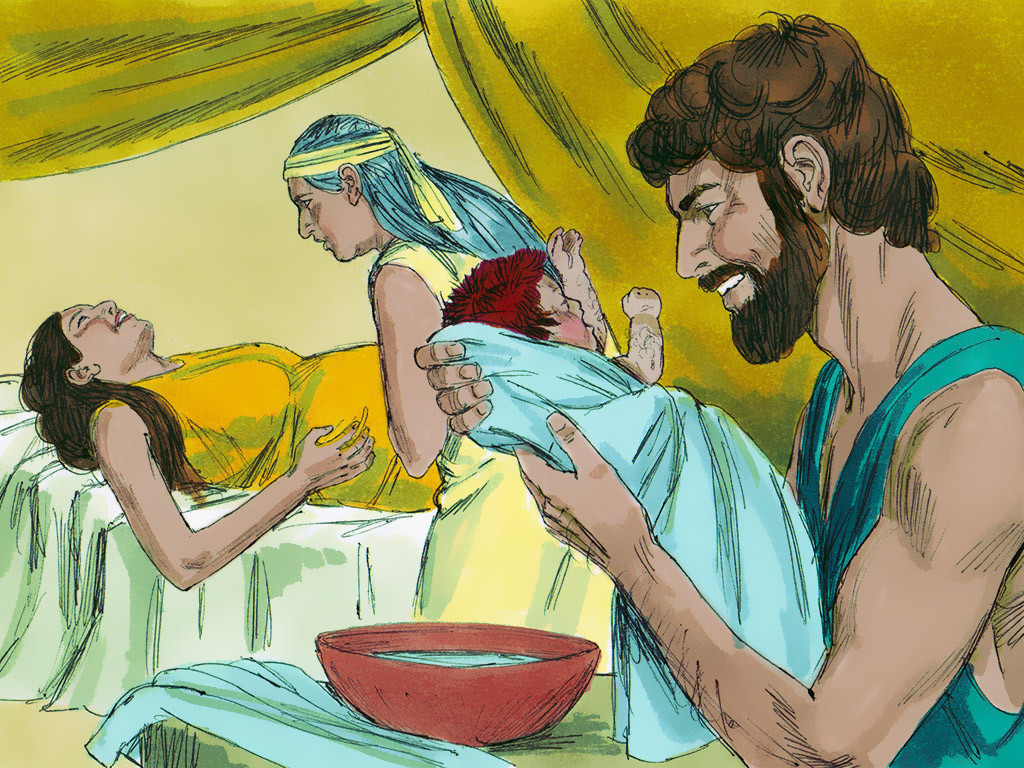
When her days to give birth were completed, just as God had said, there were twins in her womb.
The first came out red, all his body like a hairy cloak, so they called his name Esau, meaning “hairy.”

Next his brother came out with his hand grasping Esau’s heel, so his name was called Jacob, meaning “heel catcher.”
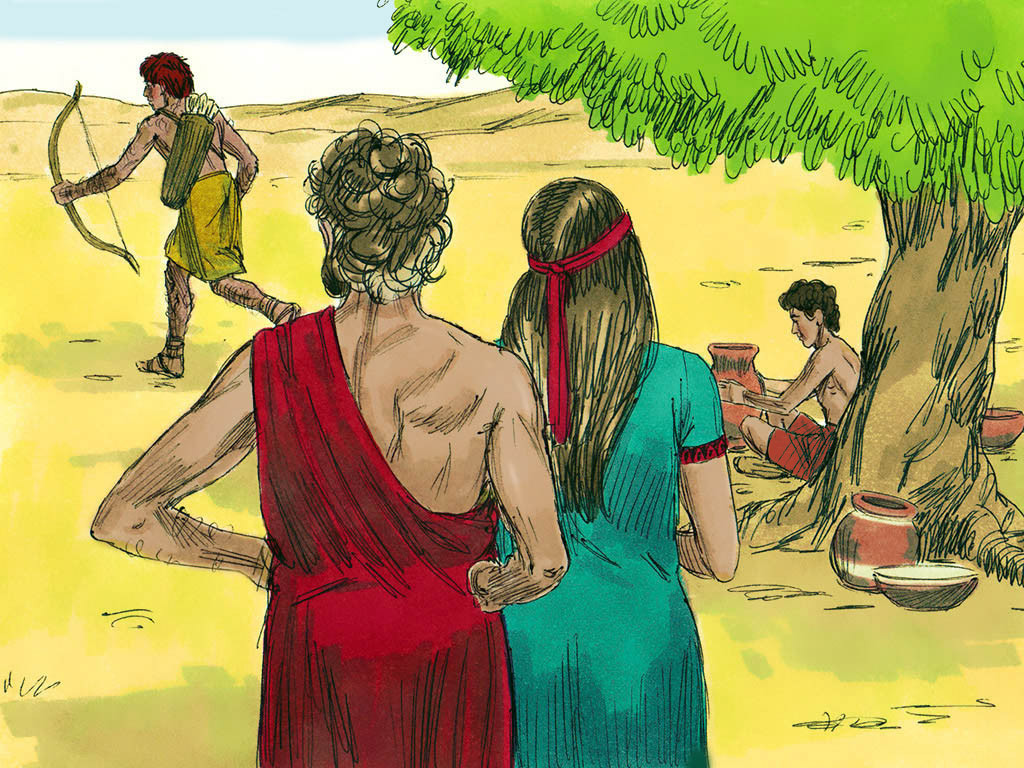
As the boys grew up, Esau became a skilled hunter, spending his time chasing game in the wildlands, while Jacob became a sedate man, spending his time on tasks around the encampment.
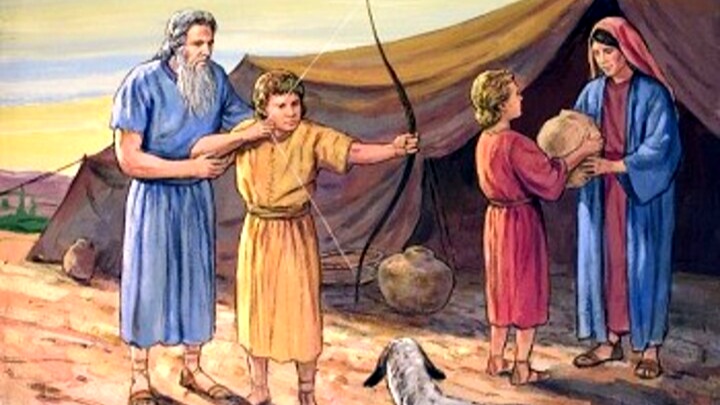
Isaac came to love Esau more because he brought the choicest of his game for his father to eat, but Rebekah loved Jacob more because they spent more time together and he was so helpful around the home.
Esau Sells His Birthright:
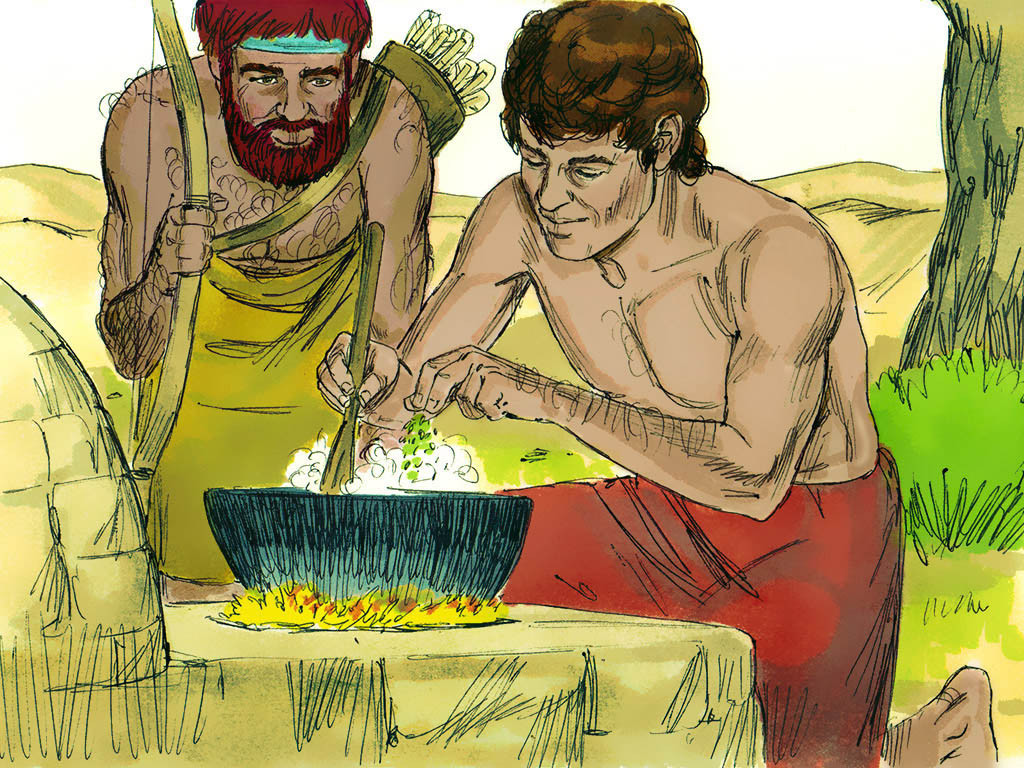
One evening, when Jacob was cooking a red lentil stew, Esau came in from a day running after game in the wildlands with nothing to show for it, and he was very tired and hungry. Esau came over to Jacob and said, in his usual gruff way, “Let me eat some of that red stew, for I am starving!” (Therefore his name was called Edom afterward, meaning “red”.)

Jacob replied in his quiet way, still stirring the pot, “Surrender your birthright to me from this day on and I will give you some of my stew.”

Esau said, “I am about to die from hunger! Of what use is a birthright to me right now?” Jacob looked at his brother with an unusual intensity and said, “Swear to me right now, that the birthright is mine from this day forward!”

So Esau swore to Jacob and surrendered his birthright to him. Then Jacob gave Esau some bread and a bowl of his lentil stew. Esau ate and drank hungrily, like a man who had not eaten all day, and then he rose and went on his way as though nothing unusual had happened.
Thus Esau did not esteem his birthright.
COMMENTARY: The best commentary on the Bible is the Bible. As I said in my introductory blog, we should interpret the historical books at the beginning of the Old Testament by what God said later about the people and events through the Prophets. Then, we should interpret ALL of the OT by what Jesus and the Apostles said about it in the New Testament. Here are some of those verses related to Genesis chapter 25:
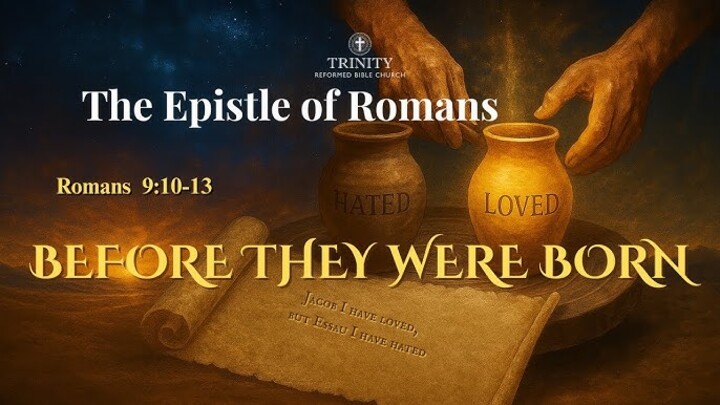
A. GOD’S SOVEREIGNTY AND ELECTION. This is related to the prophecy about how the younger twin will rule over the older twin. Paul describes it this way in Romans 9.
“When Rebekah had conceived children by our forefather Isaac, though they were not yet born and had done nothing either good or bad—in order that God’s purpose of choosing might continue, not because of works, but because of Him who calls—she was told, “The older will serve the younger.”
If you’ve ever read through Romans or listened to a series on it, you might have noticed that it’s complicated and Paul goes into some deep theology. I’ve been looking over some commentaries on Romans 9, so let me try to uncomplicated Paul’s point here.
Paul is talking about the sovereignty of God’s choice for who He will use in accomplishing His purpose and who to offer His bmessings to. God chose Abraham, we’re not told why, and made a promise to produce innumerable descendents from him, especially One who will “bless all nations.”
Abraham and Sarah, having lost faith in God’s promise, had a son by her maid, who was named Ishmael. But afterward, some visiting angels promised Sarah would be pregnant by that same time next year, and so she was, and Isaac was born. Paul’s point is that God chose Isaac over Ishmael to continue His plan because Isaac was the ‘son promised’ by God. It was God’s choice again.
Paul’s next point brings us to Isaac’s twins. God chose the younger one (Jacob) and made a promise about him to Rebecca, that he would rule over His older brother. Because Jacob and Esau were still in the womb when God made this declaration, Paul points out that God’s choice was not based on anything they had done–either good or bad. It was God’s choice, again.
The choice that Paul is ultimately addressing is, why didn’t all of the Jews (Israelites) accept Jesus as the Messiah? And, why did God chose to start saving Gentiles when they started believing in the gospel of Jesus Christ?
Paul’s point here is, just because the Israelites are physically descended from Abraham, Isaac and Jacob, the Patriarchs to whom God made and confirmed His promise, it is no guarantee they will experience redemption through Jesus Christ at that time.
Because God is Sovereign, He was perfectly justified to have Paul and other missionary teams carry the gospel to the Gentiles and to confirm the Gentiles’ acceptance into God’s Kingdom, after the Jews started rejecting the gospel. That is, God has made them (and us!) honorary Israelites, and thus joint heirs of God’s salvation with the nation of Israel. After all, that was part of God’s original promise, to be a ‘blessing to all nations.’ (The Greek word interpreted ‘Gentiles ‘ ‘ethnos,’ actually means ‘nations.”)
So, Paul’s point, in part, is that God’s choices are not based on ‘works,’ that is, what a person has done good or bad, (for example, God’s choice of Jacob in the womb.) God’s choice about who to offer salvation to is not dependent on one’s ancestry as being descended from Abraham (for example God chose Isaac over Ishmael.) BUT God’s choices are made by His own decision, that is, His Sovereign will, and God’s choices have always been proven to be the right ones and the best ones to carry out His eternal plan of salvation for humankind.
Whew! I don’t know if I uncomplicated that or not! My take on this is, God is saying through Paul, ‘So, you’re a Jew and you think that entitles you to special treatment from God over everyone else? NOT!’ I chose who, what, when, where and how BECAUSE I AM GOD!
Paul’s concludes his argument in Romans chapter 9 by quoting from Exodus 33:19, where God proclaims His goodnes, that God will have compassion on whoever He chooses to have compassion on. And God will have mercy on whoever He chooses to have mercy on.
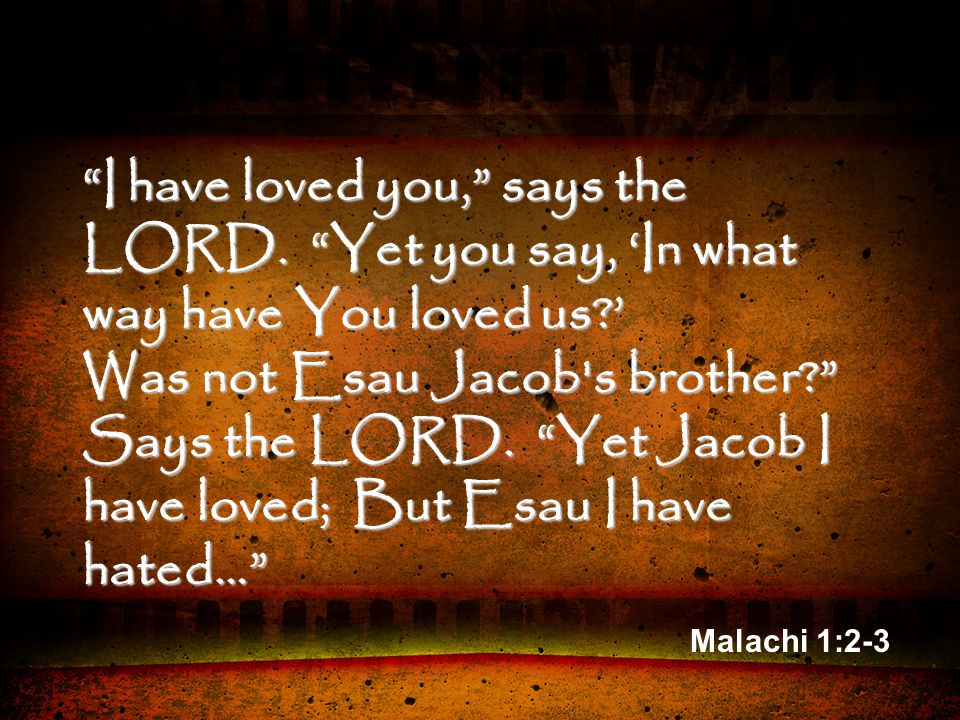
B. As it is written, “Jacob I loved, but Esau I hated.” (also quoted in Romans 10:13)
The Hebrew word translated “hated” here means to be hostile to and consider someone an enemy. The reference is to some prophecies about the country founded by Esau and his descendents, called ‘Edom.’
When God brought the descendents of Jacob back from Egypt to the land He had promised them, He instructed them to be careful not to take any land from Edom, because of the relationship between their founders, Jacob and Esau. However, when the Israelites were entering their promised land, they wanted to take a shortcut through Edom. They promised they wouldn’t take anything, they would stay on the highway, and if any of their animals drank any water, they would pay for it.
The Edomites not only said, ‘No!,’ they said ‘H#!! no,’ and lined up their army to attack the Israelites if they tried to cross. (See Numbers 20:14-21)
Again, at a later time in history, when Israel and Judah were being besieged by Assyria, leading to their defeat and exile, Edom joined the enemy of Israel by fighting their relatives, sacking Jerusalem and taking refugees captive and making them slaves. (See 2 Chronicles 28:17)
Therefore, God cursed the nation of Edom (Esau) for their treachery, and promised to completely destroy it, as He did. (See Joel 3:19, Amos 1:11, Obadiah 1:11-14, and there’s more in Ezekiel 25, 35 and 36.)
So, there wasn’t anything Esau did that caused God to ‘hate’ him. God actually honored his descendents. Instead, it was what the nation founded by his descendents did that caused God to declare them as enemies and then He become hostile to them.
Prophetic language frequently uses the name of the founder of a nation to refer to the nation, as ‘Jacob’ and ‘Esau’ are used in prophecies to refer to the nations Israel and Edom. Hence, when God says “Jacob I have loved” (feels a deep affection for), He’s referring to the nation of Israel. When He says, “Esau I have hated,” (declared a hostile enemy), He’s referring to the nation of Edom. It’s easy to get confused!
C. PROFANE / GODLESS / UNGODLY:
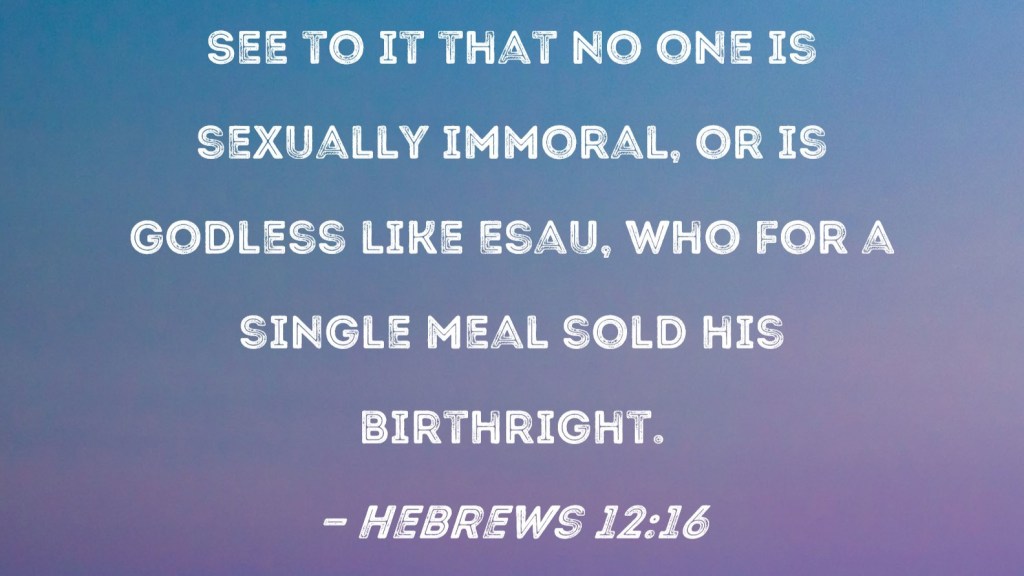
The Greek word used to describe Esau in this verse means the opposite of holy or sanctified. It is variously translated as profane, godless or ungodly. Godly people set apart the things of God as being special and important in how they treat them, talk about them, etc. Godless, ungodly or profane people treat what belongs to God as though it were ordinary or unimportant.
“This Greek word is used to label conduct, speech, or people that treat divine realities as common, trivial, or contemptible. While Scripture plainly identifies unbelief and immorality as characteristic of the profane, the term also warns believers that holiness may be undermined by careless attitudes, empty talk, and a willingness to trade eternal privilege for fleeting satisfaction.” (The Bible Hub)
That last is specifically what Esau did in reference to the Divine birthright that was his as the firstborn. Thus, we see Esau’s surrendering his birthright for one meal is condemned in Scripture, but not Jacob’s actions of wheedling it from Esau.
APPLICATIONS:
So, in light of these three Biblical commentaries, there are three (kind of obvious) applications:
1. Let us as ‘Gentiles’ thank God that He hasn’t left us out of His plan, that He has chosen to show compassion and mercy to us, and that we all have had the opportunity to be saved and redeemed from this world of sin and death, and from our own sinful self. AMEN!
2. Always remember to treat others, especially God’s chosen and blessed people, with kindness, acceptance and generosity. This is what the Bible calls ‘hospitality.’
3. Remember to treat everything having to do with God, Jesus Christ, the Holy Spirit, His Holy Bible, especially the Gospel, Christ’s Body, the Church, and God’s ordained ministers and pastors, as special and important. Never put anything above them in how you esteem them and speak about them. Remember to honor God in everything you do and say, more than what you think, more than how you feel, more than anything you might want, and even more than a anything you need. Quite a lofty goal, isn’t it? I know you fall short, so do I, but let’s TRY.

Considering the sovereignty of God reminds me of this worship song. I hope it carries you into an attitude and heart of worship as it does me. Song: How Great is Our God, by Chris Tomlin.
 Bill's Bible Blog
Leave a comment