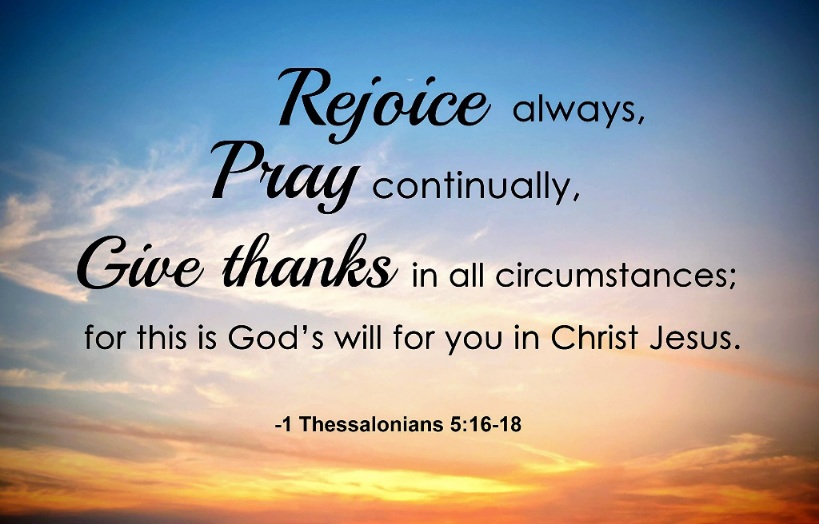
This is a new month and we have a new theme for March, praise and thanksgiving. Our first verse is 1 Thessalonians 5:18 – Give thanks in everything!
Verse 18 is actually the third in a list of things that Paul is saying we should always be doing as Christians. Here’s the full set:
According to the Greek, the this at the end of the list refers to the “substance of the preceding discourse,” in other words–ALL THREE! So from the Interlinear Bible, it reads,
“For these things are the will of God as regards you.”
What would it look like if these three things really DID characterize our lives as Christians?
REJOICE ALWAYS! What should we be so happy about all the time?
I recently heard a podcast from Doctor David Jeremiah from Ecclesiastes 9. He titled it, “The Subject Nobody Wants to Talk About,” because it was about death.
Solomon didn’t have a problem talking about it. He made the points that • death was inevitable, • death could not be ignored, • nor could death be avoided. So, what was Solomon’s response to these somber truths? David Jeremiah summarized the advice this way.
Treat every meal like it’s a feast! He pointed out that we rarely sit down and eat together anymore. The advent of fast food has somehow short circuited the family meal. But there are many relational advantages to taking the time to eat together. The Israelites knew this.
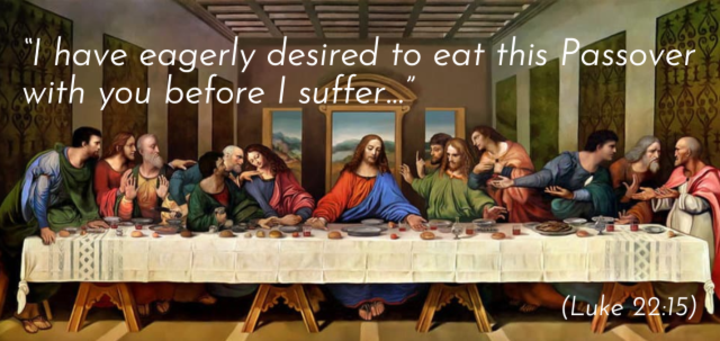
One of Jesus’ greatest desires, He said, was to eat one last meal with His 12 disciples before He was arrested.
If we add to a sit-down meal the trappings of a feast, it can also add to our enjoyment of life!
Next, David Jeremiah said we should dress up every day like we’re going to a party! I grew up at a time when people dressed up more. I look at old TV shows like Perry Mason and am reminded of this. We even had one suit reserved for going to church and special occasions called our “Sunday best.” Now people just wear a t-shirt and jeans.
I think there’s something to be said for dressing nicely. At work we try to “dress for success.” That is, dress for the job you want rather than the one you have.
In the same way, if we dress nicely, “like we’re going to a party,” maybe we’ll influence our attitude to the one we WANT to have–one of celebration and rejoicing!
One point to remember about Ecclesiastes, it very much has a “the-grave-is-the-end” attitude. For us as Christians, we now know that is not true. In a similar list of commands at the end of Philippians, Paul says,
Our cause for “rejoicing always” is more than just enjoying life while we have it, although that is a VERY GOOD reason to do so. If we center our life on Jesus Christ and the salvation He has bought for us, then we should have TWICE as many reasons to be filled with joy each day.
Start your day with a devotional time, and think about the grace and mercy of God through Jesus Christ. Maybe that will help you carry more of a rejoicing attitude throughout the rest of the day?
Pray continually! What does that mean? It sounds a little impractical to me. The Greek word for ‘prayer’ here is the general word that means to direct your thoughts and words toward God. Making God a part of your conversation…that’s prayer!
Our current series at The Summit is on Nehemiah. This week, Pastor J.D. pointed out how much prayer contributed to Nehemiah’s success at rebuilding the walls of Jerusalem.
When his brother brought him the bad news about the poor condition of the walls of Jerusalem, Nehemiah was very troubled and addressed the issue by prayer and fasting.
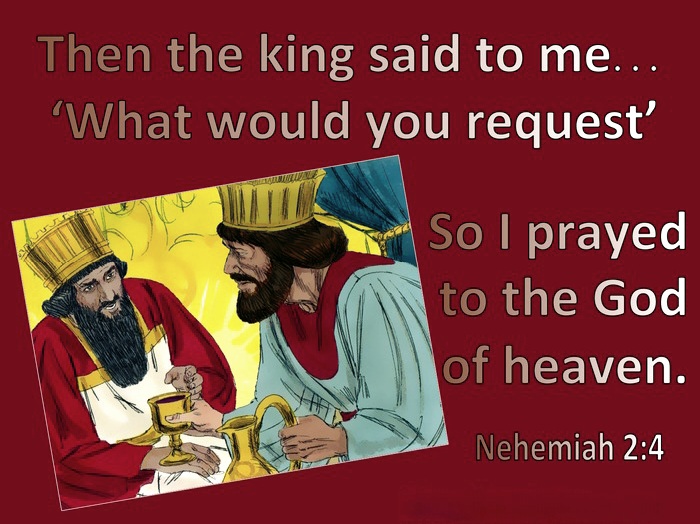
When Nehemiah unexpectedly had an opportunity to ask the king for resources, it says he prayed. It was probably one of those quick “breath prayers”.
All during the work in Jerusalem, Nehemiah regularly prayed about the difficulties that arose.
Then at the end, the last thing recorded, both in the book and in the Old Testament, was a prayer by Nehemiah to God.
Nehemiah prayed before he did anything about the problem, he prayed when he was presented with the opportunity to do something about it, and he prayed throughout dealing with the problems until the very end–THAT is praying continually.
Give thanks in all things. Note that it says to give thanks in all circumstances, not necessarily for all circumstances.
Cultivating an “attitude of gratitude” can benefit our Christian walk in many ways. Most especially, remembering to thank God in the middle of difficult situations helps to shift our focus from the problem to God’s goodness and sovereignty, and that can help reduce our worry and anxiety.
Here’s a song that might inspire you as you seek to give thanks ro God:
CONCLUSION:
God commands us to REJOICE ALWAYS, because He knows it will help us enjoy life.
God commands us to PRAY CONTINUALLY, because He has what we need to deal with the problems of life, but we need to ASK Him.
God commands us to GIVE THANKS IN ALL CIRCUMSTANCES, because He knows it will help us maintain a positive attitude and remind us of the good gifts He gives us.
Our theme for February is Remember God’s Blessings.
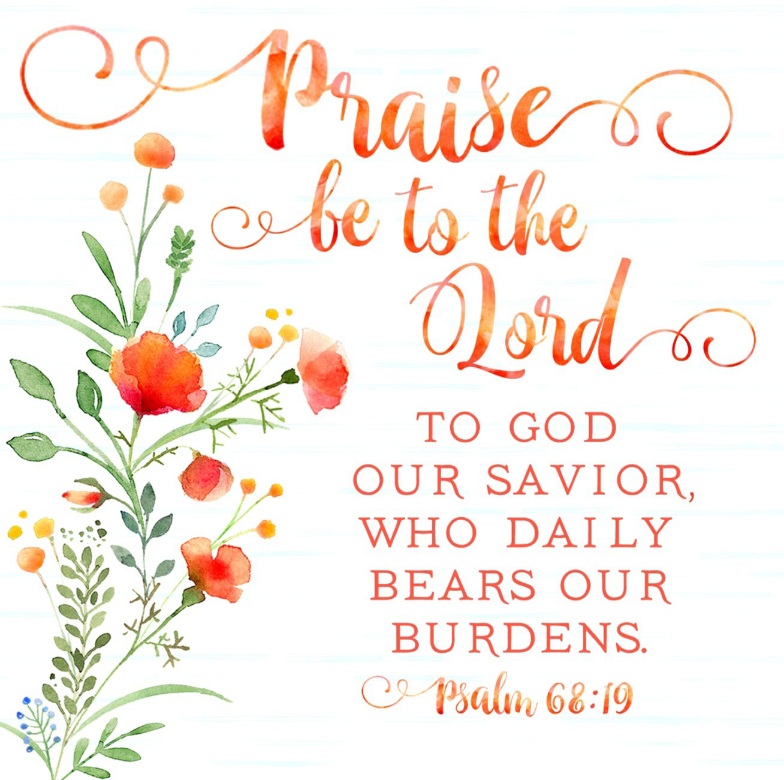
For week 3, the verse is Psalm 68:19 – Remember how He has borne our burdens!
It seems there are a couple of elements to this verse that we can do a deeper dive on.
I. “God our Savior.” This is a verse in the Old Testament. As a New Testament believer, I’ve always thought of my Savior as Jesus Christ. He’s the One who came from God, to suffer and die to pay the penalty for my sins so that I will be saved from the Judgment and eternal condemnation. So, what did the Jews think when they said, “God our Savior“?
“Stand firm and you will see the salvation of the LORD!” (Exodus 14:13).
Salvation in the Pentateuch:
In Exodus, God’s salvation of the Israelites from Egypt, especially the parting of the Red Sea, forms the foundation of the Jewish faith.
Later books of the Old Testament frequently reflect on that event so that Israel’s later generations remember God’s salvation of their ancestors as the foundation of their national identity. (See Pastor J.D. Greear’s series on Exodus.)
Salvation in the Historical Books:
During the conquest and settlement of Canaan, salvation was experienced repeatedly through God-raised deliverers. Joshua’s victories, the judges’ rescues, and the military triumphs under Saul and David, all portray God’s salvation as tangible victory over enemies.
Salvation in the Wisdom Literature:
In Psalms, salvation moves from the battlefield to the prayer closet. Personal problems replace national problems, but the action remains unchanged: crying out to the living God for salvation in the middle of sickness, slander, or sin.
Salvation in the Prophets:
The Prophets broaden the concept of God’s salvation. Isaiah links salvation with the revealing of God’s righteousness at some future time.
Isaiah’s Servant Songs climax in the proclamation that God’s salvation will reach “to the ends of the earth”. Jeremiah and Ezekiel speak of future salvation following God’s judgment.
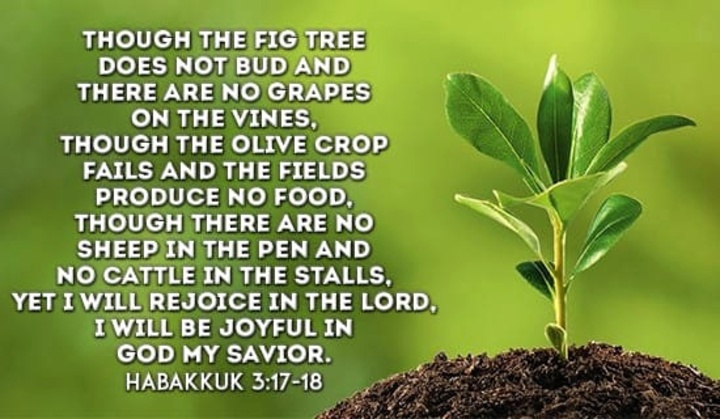
Habakkuk shows that even when circumstances worsened for Israel, the covenantal relationship between God and His chosen people guarantees ultimate salvation by God their Savior.
Messianic Foreshadowing:
Because the name “Jesus,” or “Yeshua” in Hebrew, is from this same word for salvation, it becomes a connection from the Old Testament’s promised Messiah to the New Testament’s revealed Christ.
We see another connection between the two Testaments when Isaiah’s declaration that, “God is mysalvation”, is echoed in Simeon’s declaration recorded in Luke. When he sees the infant Jesus, he declares, “My eyes have seen Yoursalvation.” So, the concept of ‘God our Savior,‘ and “Jesus Christ,our Savior,” are closely related in the Old and New Testaments of the Bible.
II. The second concept in our verse for the week I thought might be worth a closer look is the concept of “daily,” or literally in Hebrew, “day by day,” also translated ‘day after day.’ We would just say, ‘every day.‘ Let’s look at some of the things in Psalms about our relating with God and He with us on a daily basis.
What we need to do:
DAILY WORSHIP GOD – Psalm 145:2DAILY PRAY TO GOD – Psalm 88:9DAILY OBEY GOD – Psalm 61:8
What can we expect from God?
DAILY REVELATION OF GOD – Psalm 19:1-2DAILY RENEWAL FROM GOD – Psalm 90:14
And from our verse this week…
DAILY HELP FROM GOD – Psalm 68:19
So, let’s take time this week to remember how God has helped bear your burdens.
POSTLOGUE:
There is a beautiful song from Godspell in the 70’s that we used to sing in contemporary worship services. It also summarizes how we as disciples should relate to Jesus “Day by Day.”
Lyrics Day by day, Day by day, Oh, Dear Lord Three things I pray; To see Thee more clearly, Love Thee more dearly, Follow Thee more nearly, Day by day, Day by day…
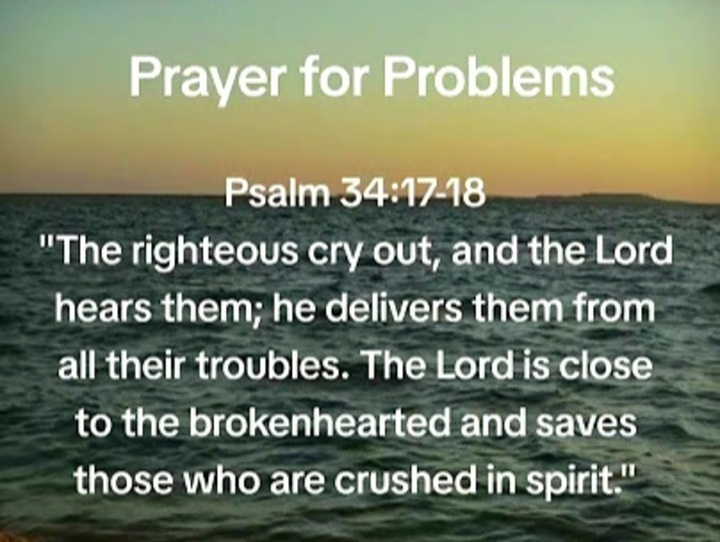
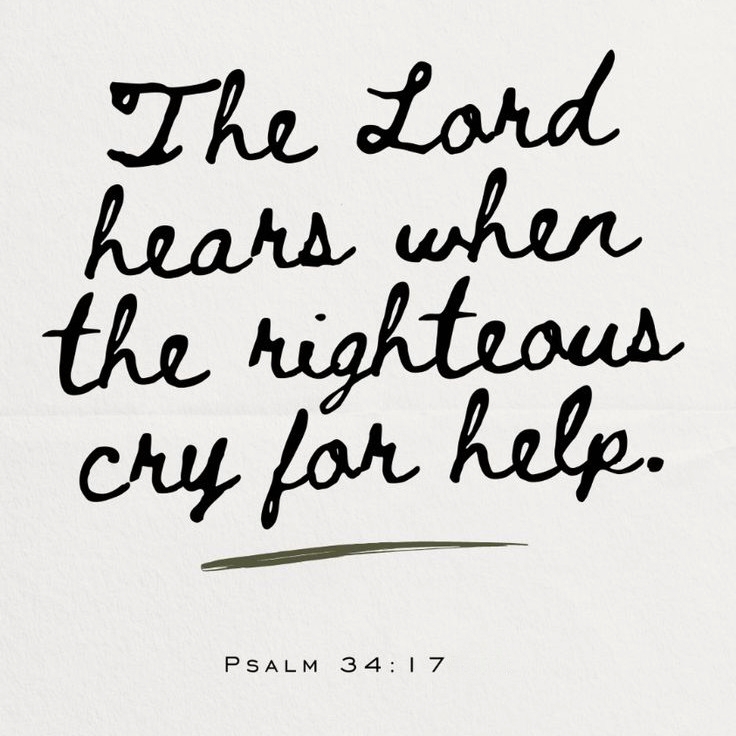
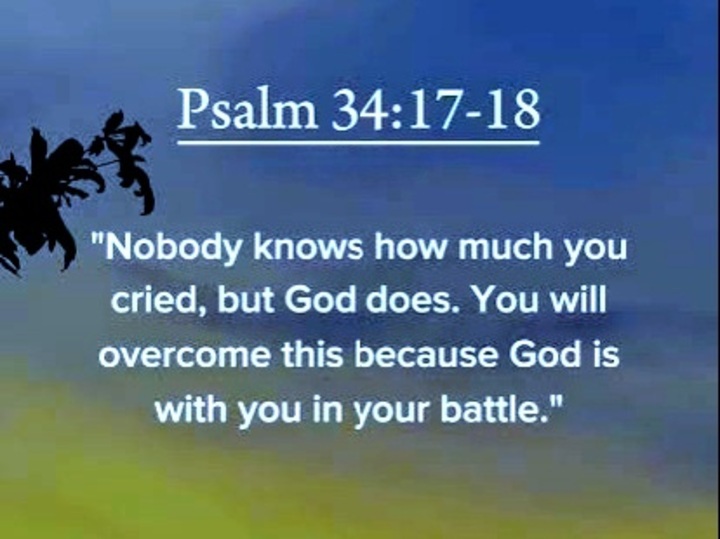
2. Psalm 34:17-18 – How He has answered your prayers:
There are many ways we can better understand and apply Scriptures. Here are some of those ways using this week’s verses.
I. Original Language. Sometimes we can understand a verse of Scripture better if we look at the original text. Translators add small words, sometimes, to help the English flow better. The added words in the following direct translations from the Interlinear Bible are in parentheses. Compare these minimalistic interpretations to how your favorite translation states these verses in Psalm 34:
CRY OUT! YAHWEH hears (and) delivers out of trouble. YAHWEH (is) near to broken-heartededness, and saves (a/the) contrite spirit.
II. Amplified. In contrast to the minimalist approach from direct translations, we can go the other direction and look at all of the different ways a particular word in the original lamguage is translated into English. Many of the Hebrew words are translated into more than one English word within the same translation, usually based on context, and dometimes translated as different English words between different translations of the Bible.
Every word in any language has an original, literal meaning (denotation), then a broader figurative meaning according to usage (connotation). Following are the expanded meaning and translation of key words from our verses:
A. Call with a loud voice. Literally ‘shriek.’ Figuratively appeal to, call together, cry out, gather together, shout, summon.
B. He will deliver. Literally to ‘snatch away’ or ‘pluck from.’ (Same as ‘rapture’!) Figuratively to defend, escape, preserve, recover, rescue, save, take from.
C. Out of all troubles. Literally a ‘tight spot.’ Figuratively = adversity, affliction, anguish, distress, tribulation.
D. God is near–in place (literal), kindred or time (figurative). • Place–near at hand, a neighbor, next to, standing by. • Kindred–close kin, kinsman redeemer, next of kin. • Time–about to, ready, shortly, soon.
E. Broken. Literatly means to ‘burst into pieces’, also translated to break down, break off, break up, destroyed, shattered, smashed, or a modern simile–torn up into itty, bitty pieces. Used figuratively for when you feel that way mentally, emotionally, and/or physically. In other words, it is used to mean a complete and total breakdown.
F. Heart. Literally the center of anything i.e. ‘the core’. Used figuratively for the feelings, the will and even the intellect. In other words, our inner person.
G. Saves. Literally to be open, wide or free. –by implication (noun) to be safe, preserved, victorious. –causatively (verb) to deliver, free, help, rescue.
H. Contrite. Literally ‘crushed to powder,’ or completely destroyed. Figuratively means “feeling and showing sorrow and remorse for improper or objectionable behavior, actions, etc.” (Websters) Biblically that would be for a sin, transgression, trespass, etc.
I. Spirit. Literally moving air like breath or wind. Figuratively the spirit–personal as well as God’s. That is, something we cannot see, but gives or shows life (breath), or shows God is acting (see John 3 for Jesus comparing the movement of God’s Spirit to the wind).
III. Paraphrasing. Sometimes it’s helpful when trying to get a mental grasp of what a verse means to cycle through all of the alternate translations of each key word, and find what makes the most sense to you, and then state the verse in your own words.
The first English paraphrase I saw was The Living Bible in the 70’s. It made what the Bible was saying much clearer than the King James version I had grown up with. A more recently popular paraphrase has been The Message. Here is verse 18 as those authors paraphrased it:
Try paraphrasing the verses to reflect your own feelings and understanding.
IV. Personalization. Another way to make a verse part of your life is to personalize it. Here is an examples from this week’s verses that’s been personalized. Use your preferred translation and write your own personal version of Psalm 34:17,18:
When I cried out in my distress to God in prayer, He heard and rescued me. When my heart was breaking and I poured my pain out to God in prayer, He felt so close to me.God freed my heart from pain when I had been crushed by life and I took it to Him in prayer.
V. Conclusion. Whichever way helps you to get a better grasp on a Bible verse, use it to remind yourself how this verse tells us God answers our prayers!
Philippians 4:19 is the conclusion of a train of thought begun by Paul earlier. I think to really understand what he is saying in verse 19, it is helpful to read the entire paragraph. Philippians 3:10-19 (NLT)
Paul’s Thanks for The Philippians’ Gifts
“How I praise the Lord that you are concerned about me again! I know you’ve been concerned for me since I was imprisoned, but you didn’t have the chance to help me until now.”
“Not that I was ever really in need, for I have learned how to be content with whatever I have. I know how to live with nothing or with everything, because I have learned the secret of living in every situation, whether it is with a full stomach or an empty one, with plenty or with little. The secret I have learned is that I can do all these things through Christ who gives me the strength.”
“Even so, you have done well to generously share with me in my present difficulty.”
“As you know, you Philippians were the only ones who gave me financial help when I first brought you the Good News and then traveled on to Macedonia. No other church did this. Even when I was in Thessalonica, you sent financial help more than once. Don’t think I’m flattering you because I want another gift. On the contrary, I’m recounting your generosity before the Lord so that you will receive a reward for your kindness.”
“At the moment I have all I need—and even more! I am generously supplied with the gifts you sent to me by Epaphroditus. They are a sweet-smelling sacrifice that is pleasing andacceptable to God. And this same God who takes care of me will also supply all yourneeds from His storehouse of glorious riches, which have been given to us in Christ Jesus.” Philippians 3:10-19
So, in conclusion, it appears that Paul is reassuring the Philippians that they can trust God to take care of their needs when they have generously, maybe even sacrificially?, given to meet his needs in his ‘difficult’ situation. Can you think of any times recently where God has met one of your needs after you have given to help someone else?
Count Your Many Blessings
An exercise that our pastor and others recommend is to sit down with a piece of paper and to recount how God has blessed you recently.
The purpose is to lead us to an attitude of thankfulness to God. Often we are not mindful of God’s many blessings toward us, so we are not as thankful to Him for His provision as we should be. If we don’t realize how much God has blessed us, we also may not trust in Him enough.
The exercise often starts slowly, but ask God to remind you of how He has blessed you by providing for your needs over the last month or so. Here’s a simple classic hymn to inspire you.
“Count Your Blessings”, by Timeless Hymns
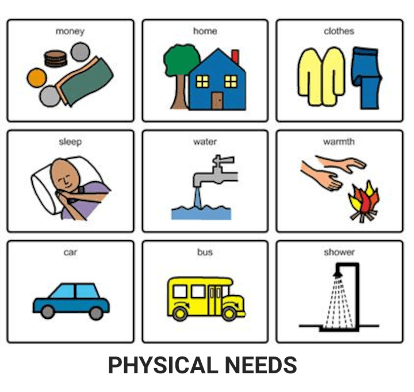
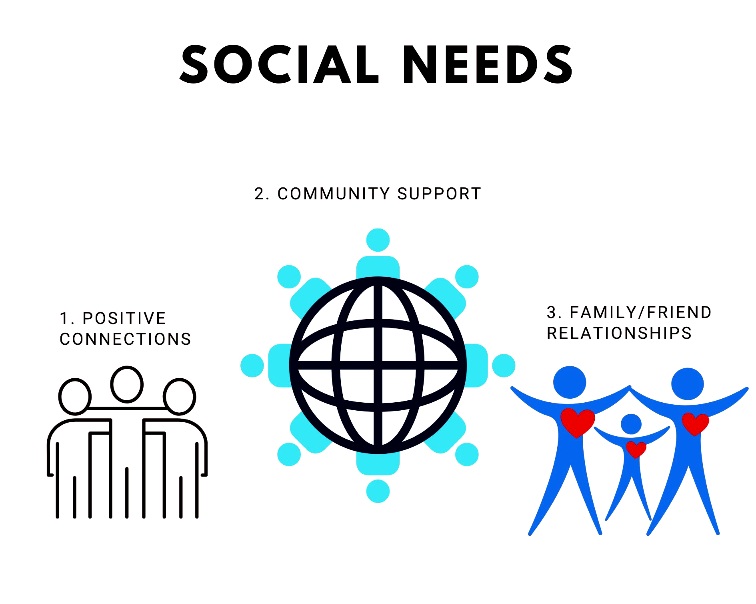
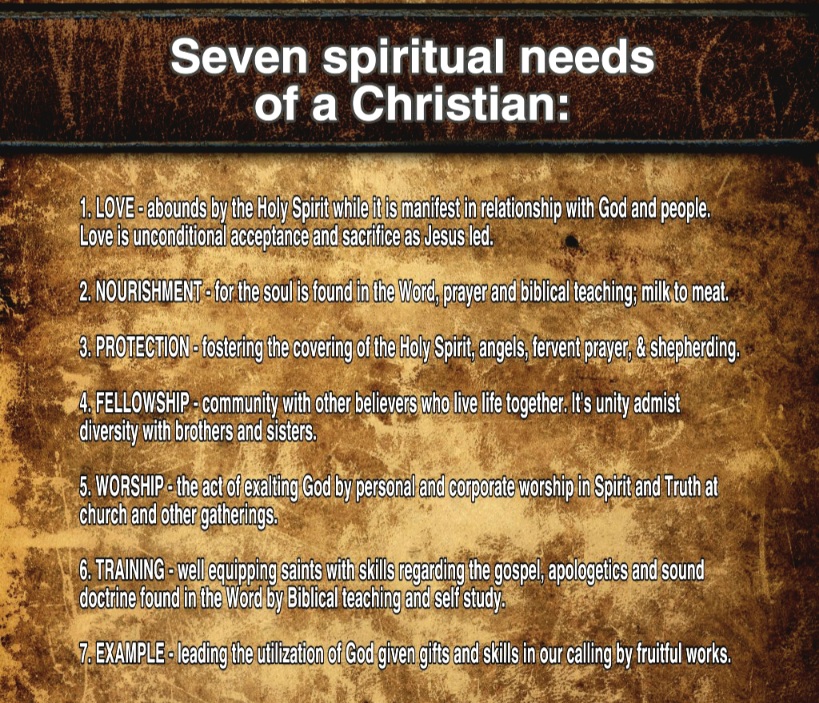
Following are the three categories of basic life needs, plus the spiritual, and ten things in each to give you some ideas to reflect on. If more come to mind, add to the list.
In addition to thanking God for His general provisions, see if you can remember when God might have made a special provision for you recently, usually in response to a prayer request.
Cleanliness Clothing Exercise Food Health/healing Money/income Shelter Sleep Transportation Water Other ______________________________
Acceptance Appreciation Communication Community Entertainment Family Friends Meaningful interaction/involvement Recreation Safety/Security Other ______________________________
PSYCHOLOGICAL NEEDS
Achievement Belonging Encouragement Enjoyment Learning Love Meaningfulness Peacefulness Purpose Understanding Other ______________________________
Acceptance/Forgiveness by God Fellowship with other believers To give and receive To experience and show God’s love To minister and be ministered to To pray and be prayed for Repentance of sins To serve and be served Instruction from God’s Word Worship of God (personal and corporate) Other ______________________________
So, this week, Remember how God has supplied your needs!
And “Count Your Many Blessings, see what God has done…” FOR YOU!
I seem to have gotten ahead of schedule for the 26 verses when I thought I was catching up from getting a late start. So as a bonus, here is one of my favorite verses from my Navigator days which I’ll ‘shoehorn’ into our January theme, “New Year’s Resolutions.”
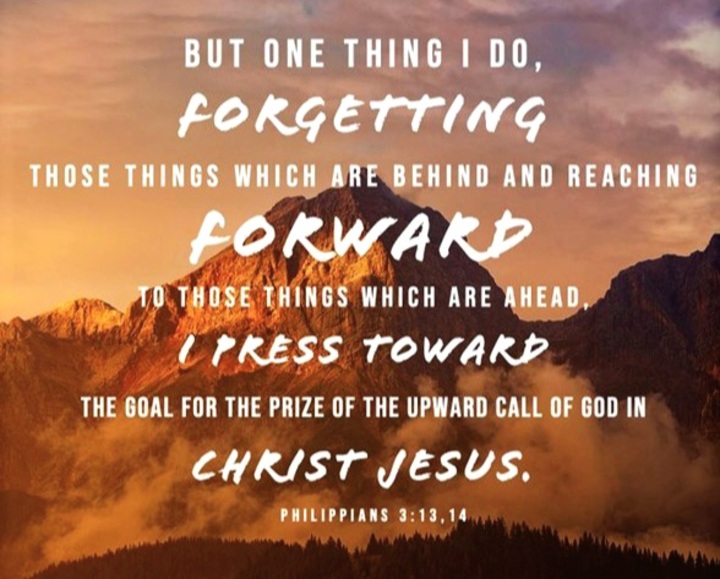
Philippians 3:13-14 – Narrow Your Focus
Let’s look at each of the parts individually.
I. “One thing I do…” Paul is emphasizing his single-minded focus on Christ and the calling he received above everything else in his life. In the previous verse, he indicated how he had not yet achieved that goal:
Not that I have already obtained this, or have already arrived at my goal, but I press on in order to take hold of that for which Christ Jesus took hold of me.” Philippians 3:12
In the Navs, they used “This one thing I do” (NASB) to say that we can do many things so-so, or we can narrow our focus and do one thing well, and that “one thing” we should be doing is being disciples of Jesus Christ.
II. “…forgetting what lies behind…”
Paul isn’t talking about amnesia, but the idea of the Greek word is “purposefully dismissing.” So, Paul means we should ‘intentionally dismiss’ the past from our thoughts in order to focus on what’s ahead in our lives. Those things in the past that might keep you from going ahead could be bad things or good things.
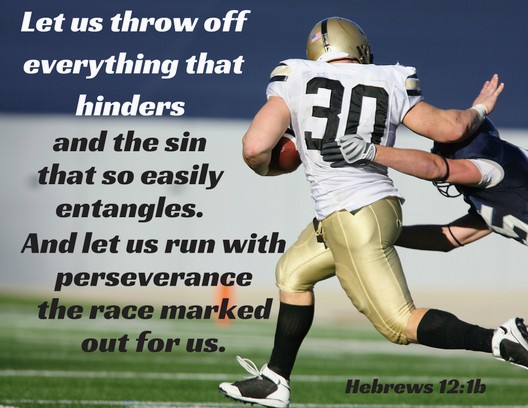
1. Past problems, failures and sins: Don’t let guilt or shame from the past cripple you. Rely on Christ’s forgiveness for your past mistakes and shortcomings. Another place where a running analogy is used to communicate a similar message is Hebrews 12:1-2:
‘Forgetting what is behind’ is Paul’s way of saying, “Don’t look back!” “Stop dwelling on the past!” In other words, don’t let anything behind you interfere with what is in front of you; that is, making forward progress in the practice of your faith.
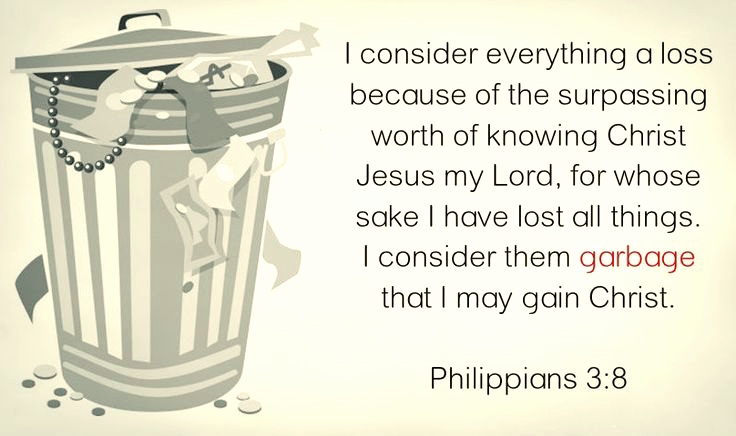
2. Past glories/achievements: Don’t become complacent and rely on past achievements in your life to carry you forward as a Christian. Paul said this about himself in Philippians 3:3-8 (amplified):
If someone thinks they have something to brag about in this life, I have even more!”
“I was born an Israelite, of the tribe of Benjamin, a Hebrew of Hebrews.”
“I was a Pharisee and lived in strict obedience to the Law. I was so zealous for the Jewish faith that I persecuted the church. And as far as the righteousness based on obedience to the Law–I was faultless.”
“But whatever things that were of benefit to me then, I now consider them as lost(gone, disappeared, no longer a part of my life) for the sake of knowing Christ.”
“What is more, I consider everything a loss (a detriment, a hindrance, valueless), because of the surpassing worth of knowing Christ Jesus my Lord.”
“For whose sake I have purposefully lost all things (kicked to the curb, forgotten about, dropped like a bad habit).”
“I now consider all those praiseworthy things to be garbage (trash, rubbish, junk) to be thrown away (discarded, cast aside, gotten rid of) that I may gain Christ in their place.” (Philippians 3:4–8, amplified)
Do you have something–whether good or bad–in your past that is holding you back from further spiritual growth? If you’re not sure, use your time during the 21 Days of Prayer and Fasting to seek an answer from God. When you find something, drop it like a hot potato!
III. “…reaching forward to what is ahead…”
Paul uses the analogy of an athlete running a race to win a prize as an illustration of how we should focus forward in our walk as a Christian.
Now, I don’t run any more, I can’t even walk fast, but as I near the finish line in my life’s race, it seems…
The way upward grows steep, as I near the end. The goal is closer, but seems further away. As I look upward to the finish line, I see heaven waiting for me. (Bill Crews, Jan. 2026)
When it comes to walking or running, our bodies tend to move in the direction our eyes are looking. This tendency was portrayed in Chariots of Fire. When Abraham looked to his left to see what the other lead runner was doing, that caused him to slow down enough to miss first place.
With this tendency in mind, Paul urges believers to stop looking back at the past and focus forward on God’s future goals. The Christian life is to be lived with our eyes focused on Jesus Christ. If we focus on Jesus through devotional time, praying, studying and discussing the Bible, worship and Christ-centered fellowship, then we will naturally move toward Him.
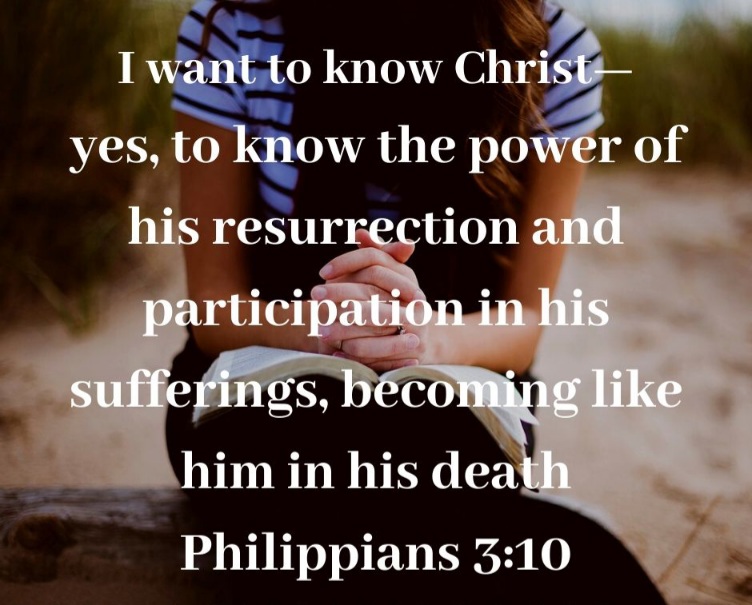
Paul expressed his version of this focus just a couple of verses before in Philippians 3:10–
Philippians 3:10 (expanded)
“I want to become as much like Jesus as is possible while on this Earth. • I want to experience first-hand the power of His resurrection, • I want to personally share in the same kinds of sufferings, • I want to be changed until I’m just like Him–willing to sacrifice myself for the sake of the gospel.
Whew! Lofty goals. I certainly have very, very far to go before I’m ready to strive for even one of these.
IV. “…I press on toward the upward call of God in Christ Jesus.”
Paul’s analogy of making a determined effort to grow in holiness and knowledge of Christ is inspired by the image of an athlete in a race, straining and running with all their might to reach the finish line first.
Our ultimate goal is the “upward call of God in Christ Jesus”. This ‘prize’ is growth in intimacy with Jesus Christ and the experience of eternal life. Another place where Paul talks about the upward focus is Colossians 3:1–
“Since, then, you have been raised with Christ, set your heart on things above, where Christ is, seated at the right hand of God”. Colossians 3:1
Paul urges us to focus our desires and priorities on heavenly, eternal realities rather than temporary earthly concerns.
“My utmost for His highest” is from a famous quote and the title of a widely read Christian devotional by Oswald Chambers, a Scottish evangelist, expressing the same total, undivided commitment to God as Paul’s:
“Shut out every other consideration and keep yourself before God for this one thing only—My utmost for His highest. I am determined to be absolutely and entirely for Him, and Him alone.“ Oswald Chambers
So, as you seek to develop resolutions in this New Year to improve your walk as a Christian, remember Paul’s example in Philippians 3:13-14–And narrow your focus!
New Year’s Resolutions: 4. 2 Chronicles 15:7 – Be hopeful !
Recently Pastor Curtis, one of our teaching pastors at The Summit, used an illustration in his sermon from the Apollo moonshot days. Seems that when they launched the Apollo spacecraft, if they were even two percent off course at the beginning, when they arrived at the moon about 240,000 miles later, they would miss their orbit and sail right on past the moon.
(By the way, this is rocket science.)
Pastor Curtis used this principle to point out that even little changes now, applied over a long time, can result in significant changes in our lives. His point was to encourage us to start making changes in our lives toward godliness. Even if we can only make a small change here and there, we could expect to reap big results later of growth in godliness if we continued.
We should trust God that doing the things He has commanded us to do will eventually bring benefits. In other words, we should never lose hope in God’s promises.
Biblical hope is a little different from worldly hope. When in the world we say we ‘hope’ for something, that means we want it to happen, we wish it would happen, but we have no idea whether it will or not, nor do we have the ability to make it happen.
At it’s best, hopeful people are optimistic, and that’s a good thing. Optimistic people are a lot more fun to be around than pessimistic people like me.
But more often worldly hope is just good wishes–it feels good when someone wishes you well, it can be encouraging, but there’s no power to make it happen beyond your own efforts and determination.
In the Bible, hope is essentially trust in God focused on the future. God has made a lot of promises about salvation and heaven that we don’t see realized yet. Therefore, if we have chosen to place our faith in God, then we sincerely believe, we have hope, that those promises will be fulfilled…in God’s timing.
The message of 2 Chronicles 15:7 seems to fall into four categories. Let’s look at some other verses about these four points.
1. STAY STRONG !
Our strength comes from how strong Godis, not how weak we are.
2. DON’T GET DISCOURAGED !
We can be courageous knowing God is with us.
3. KEEP AT IT !
We will reap a harvest of righteousness if we sow seeds of goodness.
4. TRUST IN GOD’S REWARD ! As articles of faith, we must–
A. Believe God will reward us as He has promised.
B. Believe that exercising discipline for godliness carries a double reward.
C. Believe that even the smallest act of service in Jesus’ name will be rewarded.
D. Believe that God will renew our strength when we feel too tired to go on.
So, as you resolve to make changes in your Christian walk for the New Year…
This story from my family history is intended as a companion to blog G3 26 verses for 2026 – Seek Advice.
I. DIVORCE AND REMARRAIGE:
My dad’s youngest sister, one of my favorite aunts, had been divorced by her husband. They were both small people and they had one child together, who was always small for his age and, in my opinion, a little naive about the things going on around him.
My aunt remarried a man who had been divorced by his wife. They were bigger people and had two children who were on the larger size for their ages.
Unfortunately, the older and bigger boy picked on my smaller cousin.
II. KIDNAPPED!
Eventually my cousin’s dad remarried a woman with two daughters. When she saw how much her new husband wanted his son to live with them, she devised a plan to keep him with them at his next visit.
They called my aunt and notified her my cousin would be living with them for now on. They said his small stature and reports of being bullied by his stepbrother were criminal, and if she objected, they would take her to court and sue for custody on the grounds that she was an unfit mother. My aunt asked to speak with him to verify if it was his decision to stay, but they refused. Furthermore, they said she could not ever come and visit him either.
This devastated my aunt as he was the only child of her body and she loved him very much. The next year when I was visiting, she told me about the situation and asked for my advice. She knew that my mother had divorced my father, her older brother, so she thought, having grown up in a similar situation as a child, I might have some insight that would be helpful.
It seems her new husband was all about charging up there and taking him by force (the bully apple didn’t fall far from the tree in his son). My aunt was a gentle person, that was one of the things I liked the most about her as most of the rest of my father’s family were very brash. I’m sure you’ve heard that opposites attract, and you couldn’t get any more opposite than my quiet aunt and my forceful new uncle.
But there is a reason that opposites attract. You see, sometimes my quiet and unassuming aunt needed a forceful advocate on her behalf. And sometimes my new uncle needed someone to rein in his overforcefulness. They were able to do these things for each other because of their love, appreciation and respect for each other, and they ended up making a very good couple.
My aunt further explained she had sent birthday and Christmas gifts, but didn’t even know if he had received them. She had tried to talk to him by phone many times, but had been refused and threatened each time. Her question for me was, “What should I do?”
III. THE ADVICE:
Whew! I guess you know you have achieved adulthood when a member of your parents’ generation asks for your advice. Turns out I had a lot to draw on for my advice.
I had not only lived in a broken family with its dynamics, but divorce had become increasingly prevalent during the mid to late 60’s, my teenage years; therefore I had the stories and experiences of many peers to add to my own.
But I had more than ‘worldly’ experience to draw on, I had become a Christian while living with my grandparents between my own family’s divorce and remarriage, so I had the wisdom of God and the Bible as part of my life. The advice I gave my aunt would not have been popular, it was not easy to follow, but it was the right thing to do.
I explained that her son’s new stepmother sounded like a manipulator. (*See NOTE at end for more information.) A manipulator will say anything, true or not, to accomplish their chosen goal. A manipulator will spin everything that is said or done in such a way as to support their viewpoint.
I told her (and my listening uncle), that the last thing they wanted to do was to storm up there and try to take back her son by force. The manipulator would have the law out there quickly, hysterically accusing them of all sorts of heinous acts, either hoping something will stick or goading them into some ill-advised act or words that they could spin. It would be ugly.
Instead, they should play it low key. She should continue to send birthday and Christmas presents and cards. She should continue to write him and tell him how much she loved him and missed him. Even if he never saw a single one of her cards or letters, whenever the manipulating stepmother would tell him that his mother didn’t love him, had even deserted him, even my naive young cousin might pick up on how hollow the words were, because even the manipulator knew differently.
I assured my aunt that one day, her son would turn 18, he would leave his new family and he would remember the mother who bore him and loved him.
IV. REUNION:
My aunt and uncle’s chance to track down my cousin the summer after his high school graduation came when a very powerful hurricane made landfall and created a swath of destruction through the area where the father’s family lived. My aunt packed their suitcases, my uncle threw his chainsaw in the back of the car, and they headed in that direction to help with the cleanup.
A terse meeting occurred at the father’s house, but my cousin had moved into an apartment with a friend at a nearby junior college in preparation for starting classes that Fall. My aunt and uncle obtained his address and phone number and went back on the road.
They made a call when they arrived in the area to let him know they were coming and to obtain some directions (this was before cell phones), and the visit was arranged.
The reunion was subdued at first. My somewhat naive cousin was confused between what the manipulator had been telling him the past few years and the totally unexpected presence of the mother who had supposedly abandoned him.
“You never called!” He said. Then my aunt replied, with the calm confidence of the truth, “I called, but they would not let me speak to you.”
“You never wrote!” He complained. “I wrote you every month and sent you Christmas and birthday cards and presents,” she replied.
“How can I know you’re telling the truth?” My aunt countered with the truth, “Every birthday and Christmas, your father would tell me your size and what you needed the most. I always sent you an appropriate gift and a card with a letter. Give me any of your birthdays or Christmases in the last few years and I’ll describe what I sent. Then you tell me if you received it or not.”
It didn’t take long for even my naive young cousin to realize the scope of the deception that had been perpetrated on him the last few years. Yes, he had received those presents, wrapped and labeled as being from his dad and stepmother. No, he had never received any of his mom’s cards or letters.
“What do you want?” finally asked my cousin, reeling from realization of the years of deception, and not knowing who or what to trust.
My aunt stated simply, with tears running down her cheeks, “I wanted to see you, as I have not seen you for so many years. I wanted to talk to you, as we’ve not been able to talk. I want to let you know that I love you, I care about you, and I want to be part of your life.”
(Just in case you’d like to listen to the song I pulled my title banner from.)
Despite my cousin’s veneer of naivety, deep down he knew his mother. He knew that she wouldn’t lie to him, and the truth was evident in every word she spoke and in every line of her body. With that realization finally came the expected teary reunion between mother and child.
Thereafter followed reciprocal visits during holidays and school breaks. When my cousin graduated, he got a job close to his mother. Unfortunately, my aunt died prematurely of cancer, but for many years, she had her only son back in her life and was able to participate with great pleasure and joy in his life as an adult.
V. CONCLUSIONS:
Might this reunion have still happened without the years of suffering and sacrifice? Might they still have come back together as mother and son without her hands-off and month-by-month faithfulness in what appeared to be a hopeless and lost cause?
We can never answer ‘might have’ questions like that. But I was able to give her godly advice that worked. I also constantly supported them in prayer, which allowed me to rejoice with her when she was reunited with her son.
That’s why the Bible instructs us to seek wise, godly counsel when faced with difficult decisions and situations. I am very grateful my aunt was not an impulsive person, unlike her second husband, but I tried to tailor my advice to what I knew about her and about my cousin, as well as general experiences and principles.
The question at this point is, how can we tell who will give us the best wise counsel? There are hints in my story, but I will save that discussion as an idea for another blog.
VI. THE ‘PRICE’ OF GODLY COUNSEL:
So, what is the “price” of (following) godly advice I refer to in my title?
It would have been very emotionally satisfying for my step-uncle to go storming and breathing threats to recover his stepson, but it would not have accomplished God’s purposes. James writes:
Losing one’s temper is easy, holding it in and channeling it into a long-term, constructive plan is very, very hard. Believe me, I know.
I learned a lesson in the 70’s that I have to keep reminding myself about. I learned that we have two choices when it comes to how we react/respond, but we don’t have a choice about what happens afterward. Here is a quote that expresses what I learned:
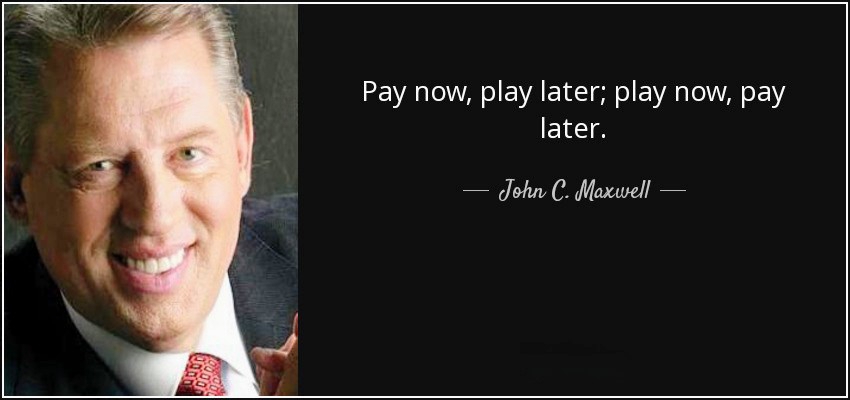
“Life demands a price. You either pay now or pay later. It is much more expensive to pay later because life charges interest.” — Matt Worthy
(Emphasis added.) So…
1. We can choose to be undisciplined and ‘invest’ in the immediate gratification of sin, but we will find that it results in penalties to us over and over again for a very long time.
2. On the other hand, we can discipline ourselves and ‘invest’ in righteousness. If we choose the path of patience and sacrifice, we may suffer, over and over again for a long time, but righteousness will eventually pay us dividends rather than charge us penalties.
It’s the same decision we face with our money, spend it all now and have nothing later; or sacrifice and save some now and have more later.
VII. NOTE – The ‘Manipulative’ Stepmother:
(AI) The “manipulating stepmother” is an archetype representing toxic behavior within blended families, often characterized by controlling actions, attempts to isolate the child from the biological mother, and causing strain on relationships with the father.
Key Aspects of a Manipulative Stepmother
1. Controlling Actions: A manipulative stepmother may use guilt, shame, and controlling behavior to get her way. This can include controlling communication between the child and the other parent, and otherwise creating a hostile, competitive environment.
2. Isolating Child from Biological Mother: A common tactic is undermining the biological mother by constantly criticizing her, badmouthing the biological mother, and trying to diminish her role in the child’s life by limiting contact and communication.
3. Strain on Relationships with Father. The manipulative mother often feels they can get away with these abusive strategies because the husband/father has chosen her. If he does not remain passive, but attempts to intervene or ameliorate her abuse, then he becomes the target of her insults, threats and other means of keeping him in line.
Psychological and Emotional Impact on Children:
1. Low Self-Esteem and Inadequacy: Constant criticism, belittling, or conditional affection can make children feel unworthy or not “good enough”.
2. Anxiety and Depression: The stress of living in a tense, unpredictable environment often leads to anxiety disorders and depressive symptoms.
3. Trust Issues: Children may develop difficulty trusting others and forming healthy relationships in the future, often fearing that affection is a contract that can be revoked.
4. Emotional Detachment: Children may withdraw from family life, shut down emotionally, or become detached as a defense mechanism.
5. Guilt and Fear: Manipulative tactics, such as emotional blackmail or, in extreme cases, threatening suicide, can leave children feeling guilty or constantly afraid of triggering the stepmother.
VIII. A Personal Response:
A manipulative person doesn’t suddenly become that way just because they married into a blended family. The above manipulative techniques are usually already well-developed aspects of their psyche. I didn’t know my cousin’s dad, but I suspect at least a part of his son’s naiveté was inherited from him.
My other impression about manipulative people and marriage, and a manipulative personality is not limited to women, is they specifically look for a spouse that they can manipulate and dominate. For a manipulative man, that dominance more often leads to physical abuse.
As far as what we can do to help friends or family that we think might be falling under the influence of a manipulative person? I’ve got no great advice beyond praying for them and trusting in the power of God to deliver them.
I do know the first step of a manipulative person is to isolate the potential victim from their friends and family. If we catch that attempt at isolation soon enough, we can try to counter by drawing closer in our relationships with them. If we don’t catch the isolation soon enough, then they can become ‘brainwashed’ and strongly resist any efforts we may try to help them, even seeing us as their enemy.
In the end, I believe there is no hope for deliverance except through the redeeming power of Jesus Christ. Here’s a great song about how Jesus can break every chain that ties us down in life.
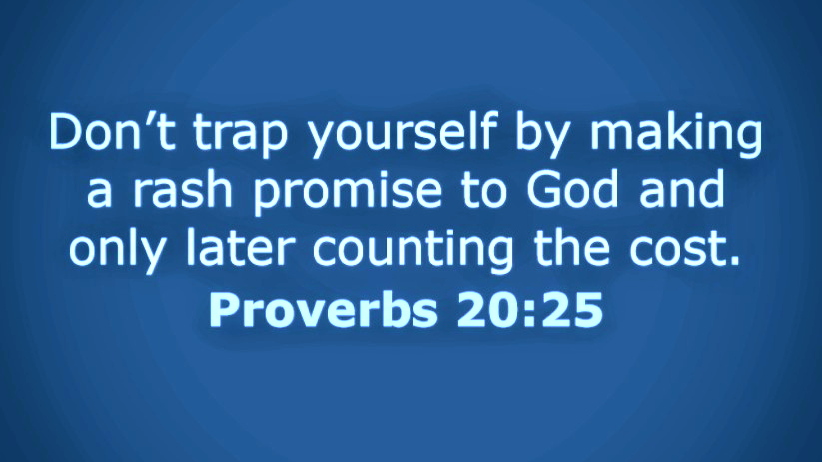
New Year’s Resolutions: 2. Proverbs 20:25 – First, be thoughtful:
One of the pieces of advice my dad frequently gave me was, “Look before you leap.”
Like most boys, I was impulsive, ‘leaping’ to conclusions or ‘leaping’ into action without taking the time to first think it through.
Jesushad a couple of parables with similar messages inLuke 14. 1. Verses 28-30 – First, count the cost:
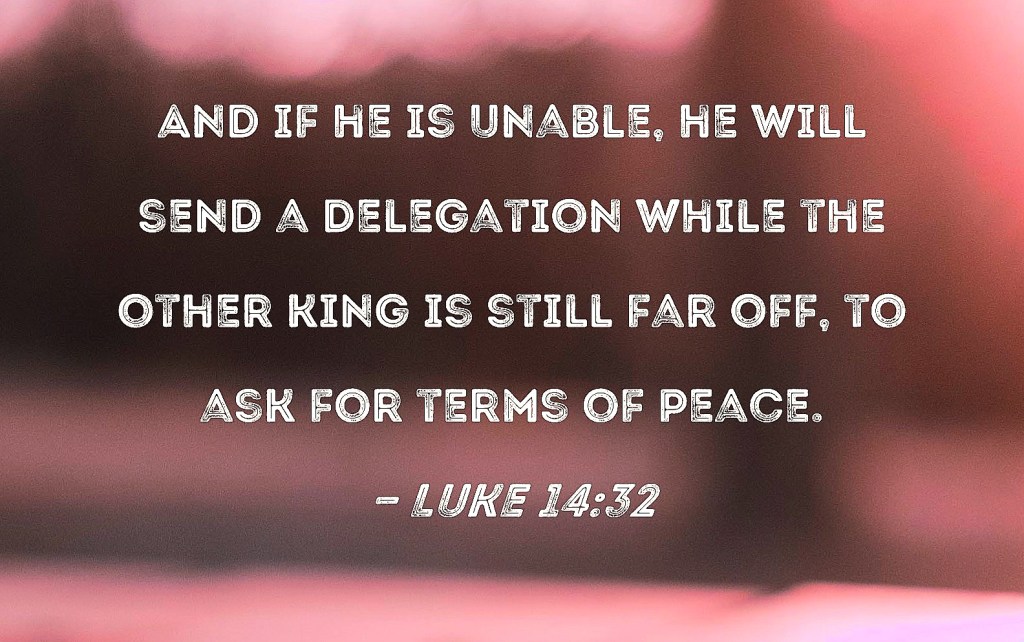
2. Luke 14:31-32 First, make sure you can:
3. Luke 14:33 The context of these parables is discipleship…
…and that is the context of these first four verses of the 26 for 2026–resolving to make advances in your growth as a Christian disciple for the New Year.
Today’s message from Joel Osteen was from Joshua 3:5. Joshua told the people,
The verb translated here as ‘purify’ is also translated as ‘sanctify’ and ‘consecrate.’ DEFINITIONS:
📖 Sanctify: a. Set apart as or declare holy, consecrate. b. Free from sin; purify.
📖 Consecrate: a. Make or declare sacred. b. Dedicate formally to a religious or divine purpose.
📖 Sacred: a. Sanctified by connection with God. b. Dedicated to a religious purpose.
As you can see from the definitions, these concepts are all closely intertwined.
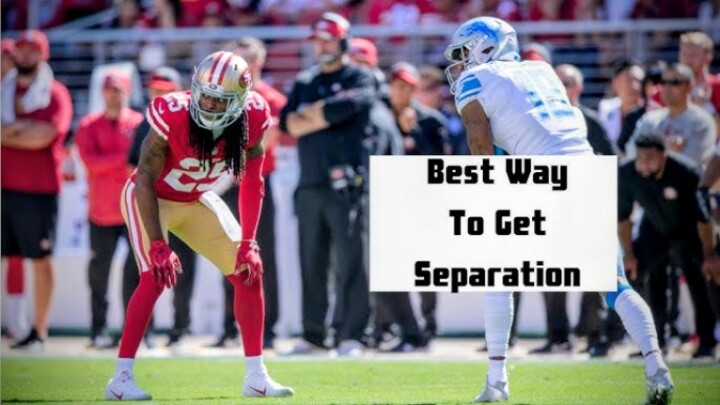
Joel explained that the idea of the Hebrew verb is to put some separation between you and those things God doesn’t approve of, those things that are not consistent with who He is.
Joel used a football illustration, appropriate for this NFL playoff season, explaining that in order for the quarterback to successfully throw a receiver the football, the receiver had to create some separation between himself and the opposing player defending him. Otherwise, it wouldn’t be safe to throw him the football, so the quarterback then checks other possible receivers.
In the case of the Israelites in the Book of Joshua, the first miracle coming up was the parting of the Jordan River, similar to, but on a smaller scale, than God parting the Red Sea for Moses. In order to participate in this miracle, Joel pointed out, the people needed to purify / consecrate / sanctify themselves.
Next miracle up was the walls of Jericho tumbling down, but if the Israelites didn’t purify themselves, then Joel said they would be left behind and miss out on the miracles to come.
Joel then applied the concept to us in our time. He said that he believes God has miracles planned for us, but first we must purify ourselves from those things that hold us back in our Christian walk and separate us from God. We need to put some separation between ourselves and our sins.
Paul listed some of those sins that we need to throw off in Ephesians chapter 4:
“Put off your old self, which belongs to your former manner of life… Therefore, putting away falsehood… Let all bitterness and wrath and anger and clamor and slander be put away from you, along with all malice…”
These qualities are like the uniform for the other team. God is not going to toss us the ‘football of blessing’ if we’re wearing the uniform of the Enemy!
And Paul doesn’t just write about those negative qualities we should cast off, he also lists those positive qualities we should put on in their place:
“…and put on the new self, created after the likeness of God in true righteousness and holiness. …let each one of you speak the truth with his neighbor, for we are members one of another. …and be kind to one another, tenderhearted, forgiving one another, as God in Christ forgave you”.
THIS is the uniform for GOD’S team.
• Instead of being sinful, we’re to be holy and righteous. • Instead of lying, tell the truth. • Instead of being bitter and angry, we’re to be kind. • Instead of ‘clamor and slander, ‘ that is making a fuss and bad-mouthing each other, we’re supposed to be forgiving. And, • Instead of treating each other with malice, we’re to be tenderhearted toward one another.
📖 Definition: ‘Malice‘ means the desire to cause harm or injury to another, stemming from a hostile impulse, deep-seated meanness, or revenge, often without justification. It’s a key concept in law for proving crimes like murder (malice aforethought) or defamation (malicious intent). The Bible calls all that ‘sin.’
Our church is beginning it’s annual 21 Days of Prayer and Fasting today. For the next 21 days, we’re supposed to give up something–a meal, watching a TV show, time on social media, etc.–and spend that time in prayer asking God this question, “God, what do you want?” and then LISTEN for His answer.
We’re supposed to be seeking God in prayer for the purpose of finding out what HE wants us to do for Him individually, and corporately as a church.
One implication of asking God what HE wants of us is that we are committing to do whatever He tells us.
Our second verse for 2026 suggests we should first be thoughtful before we commit to obey. Are we really willing to do what God asks of us? Are we ready to act in F.A.I.T.H? Are we ready and willing to carry it through? Consider these questions first, before you commit yourself to a new resolution.
Happy New Year everybody! My life has been changing at the speed of light the past few weeks, but we mortals still react to change at the same plodding pace. I’ve plenty of opportunities to trust God and to show His grace, but I can always use some inspiration.
I was looking for some inspiration on the Internet the other morning and I came across “26 Verses for 2026.” Just what I was looking for! (Funny how that happens…) So, I’m going to share one each week, along with my thoughts. Maybe you’ll find inspiration from them too.
January: Verses About Resolutions
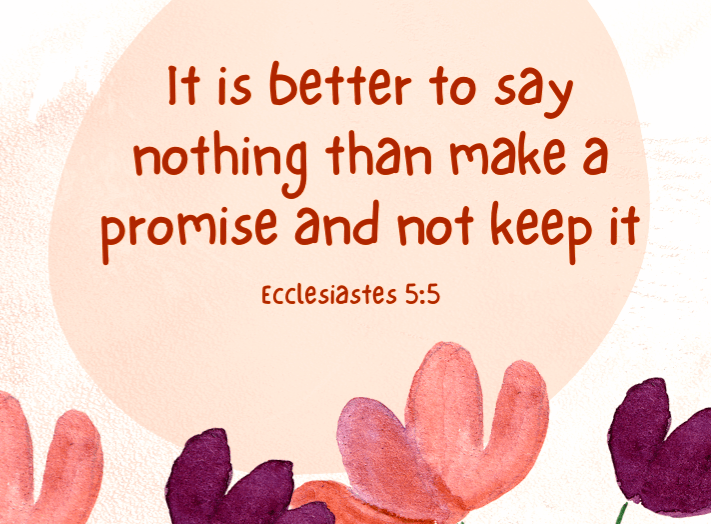
1. Ecclesiastes 5:5 – Be Commited:
I heard on the news this week that most people are making the same New Year’s Resolutions they made last year–to exercise more, to eat better, to save money, to lose weight–but since resolving to do those things last year didn’t work, what’s the likelihood it will work this year?
You might also have seen practical suggestions for being more successful with your resolutions:
1. Break your goals down into smaller steps and focus on accomplishing one step at a time. 2. Set specific, realistic, and small goals, like something for each day, week, month…3. Focus on developing positive habits rather than just stopping bad habits.4. Find someone you know who is doing the same thing and do it together. 5. Celebrate your progress, but not by breaking your resolution!
One of my resolutions, when I got off my oral chemo last month, was to lose the weight it had caused me to gain. So far I’ve lost 7 pounds. Woo-hoo! Much farther to go, though, but I’m committed to following my plan…
Making changes to your physical and mental habits is hard! But do you know what is even harder? Making SPIRITUAL changes.
You see, God made us in His glorious image, not on the outside, but on the inside. Our character is supposed to be a reflection of who God is. For example:
God is the Creator–we are creativeGod is all-powerful–we are powerful in our own ways.God is all-knowing–we are capable of learning and knowing things.God is just–at our best, we know what is fair and just.God is love–at our best, we too are capable of great love.
Notice my qualifier “at our best.” You see, there’s this thing called “sin.” Humankind at the beginning turned from God in disobedience and this forever scarred our psyche. Instead of living to the glory of God, our nature was turned upside down and inside out, and now we live to glorify ourselves.
That doesn’t sound so bad, until you realize we are supposed to love each other to the point of sacrificing our own needs and desires for other’s good. Turn that around and you get people who love themselves most of all, and who are willing to sacrifice anything and everything of the people around them, to fulfill their own needs and desires. That results in some very ugly things in this world.
Mankind often exercises it’s power for destroying rather than creating.
When we choose to come to God by faith in Jesus Christ, God begins a process of reversing the harm of sin in our lives, both from our sin within and from others’ sin from without. That means fundamentally changing who we are on the inside.
Just as I am…I come
You might wonder, “Doesn’t God accept me as I am?” Yes, He does. He doesn’t require that we try to make these changes before He accepts us, because WE CANNOT!
God meets us wherever we are in life when we come to Him–He accepts us as we are, but then He redeems us from sin and darkness, and He brings us into His glory and light. He loves us so much, He won’t leave us where we are–in a pit of sin, darkness and despair.
But real, deep down change of who we are doesn’t happen immediately. We have to walk out what this means for the rest of our lives. You see, every day is a New Day in the Christian life. Therefore, every day requires a New Day’s Resolution.
So, let’s start each day in our relationship with God by making a committment to Him. Follow through on that PROMISE YOU MADE TO GOD when He first redeemed you.
























































































































 Bill's Bible Blog